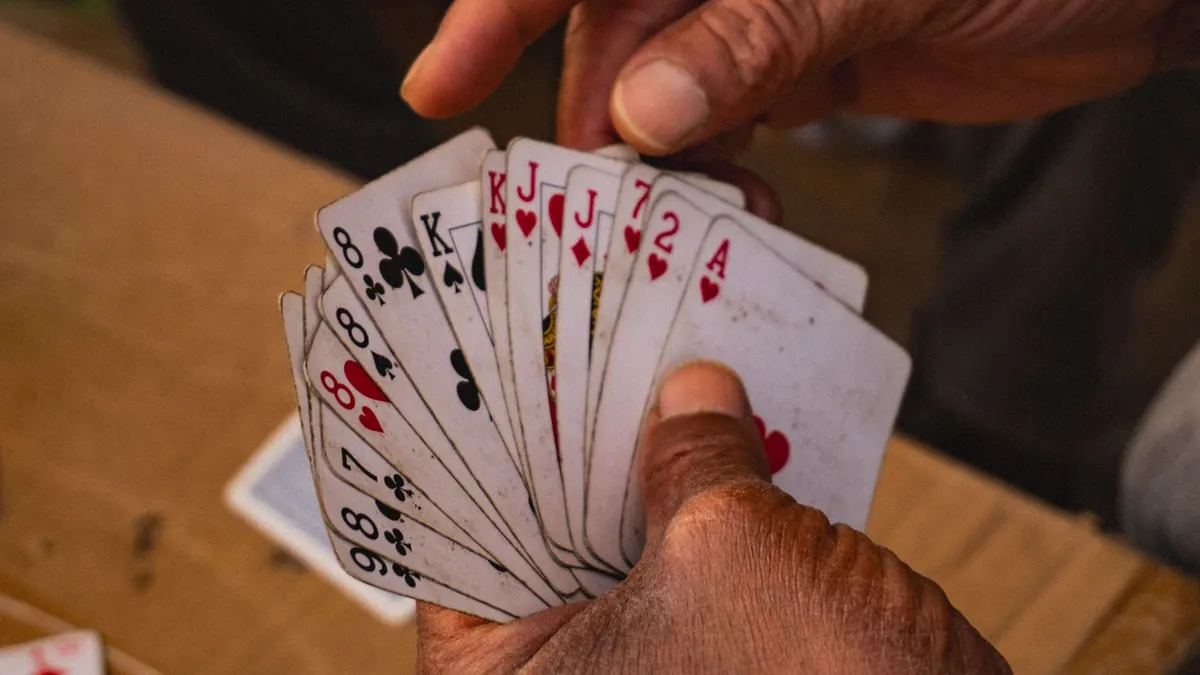
How to Count Winners and Losers During the Play: A Step-by-Step Guide
The opening lead is face down, dummy is about to appear, and a small voice in your head says: just play something. That voice has cost more tricks than any finesse gone wrong. Before you touch a card you need two numbers — how many tricks you can cash right now, and how many you are likely to lose. Get those numbers and the play almost writes itself.
Counting is not a talent. It is a habit with a fixed order, and it takes about thirty seconds.
Make the Pause a Ritual
Treat the moment dummy appears as untouchable. Do not call for a card, do not straighten the dummy, do not sigh at the lead. Look at the twenty-six cards in front of you and count.
Count in the same order every time — spades, hearts, diamonds, clubs — so you never finish a hand and realise you never thought about the club suit at all. Do it that way for a few sessions and the count will start arriving before the opponents have finished turning the lead over.
What makes this easy is that you can see everything. The opponents are the ones guessing.
Counting Winners at No Trump
At no trump, count winners: cards that will take a trick without losing one first. A top card is a winner. So is the fourth card in a suit once the opponents have run out.
Work suit by suit and count only what is certain. With K Q J opposite three small cards, that is three tricks, not "three or four depending." With A Q opposite small cards, count the ace and treat the queen as a possible extra. Finesses belong at the end of the count, not the beginning, because a plan built on a finesse alone has no backup.
When your certain tricks fall short, do not stop — ask where extra tricks can come from. The longest combined suit is usually the answer. Suppose you hold seven cards in a suit missing the ace, with K Q J in one hand. You can take three tricks immediately, and if the missing cards split 3-3 the two small cards left in the long hand become winners too. Three now, a realistic chance of five later. That is the arithmetic that decides 3NT contracts.
Two things to check before you cash anything:
- Communication. Count your entries to the hand holding the long suit.
- Blocking. If one hand is short in a suit, cash the high cards in the right order so the suit does not jam.
A winner you cannot reach is not a winner.
Counting Losers at a Suit Contract
In a suit contract the useful number is usually losers, and the habit to build is counting them from the hand with the longer trump holding. That is normally your own hand — the one that will still be holding small cards after dummy's trumps have been spent on ruffs.
Go suit by suit and ask how many tricks that suit must surrender. Look only at the first three rounds; you will never have time to mourn the fourth small card. A 8 6 opposite K 4 2 covers two rounds, so the third round loses unless the suit breaks 3-3. That is one potential loser, not two.
Quick losers come first
Once you have a total, pick out the quick losers — tricks the opponents can cash immediately, before you have drawn trumps. If the opening lead has knocked out one of your side-suit stoppers and the opponents still hold a trick there plus the ace of trumps, there is no time for a leisurely plan. Count the quick losers and deal with them first.
Trumps are a resource, not just a suit
Three small trumps in dummy are three potential ruffs, which means up to three losers in your hand can vanish. But ruffing and drawing trumps compete for the same cards. Decide early which you need more, because you cannot usually have both.
Comparing the Count With the Contract
Now put the numbers side by side. At no trump you need nine, ten or eleven winners. At a suit contract, subtract your losers from thirteen and see whether the answer matches the level you bid. The gap tells you what the hand is about.
If you are one or two tricks short, choose a technique to close it:
- Ruff losers in the short-trump hand — usually the cheapest route, but check you can still draw trumps afterwards.
- Discard losers on a long suit — typically in dummy, and typically after knocking out the opponents' stopper.
- Establish a long suit — count how many tricks you must lose first, and confirm you can afford them.
- Take a finesse — good as a bonus, dangerous as the whole plan.
- Duck a trick early — sometimes giving up a trick now keeps the entries you need later.
The count is not the plan by itself. The plan is a sequence: draw two rounds of trumps, then play on diamonds, then use the club entry to reach the long suit. Say that sequence to yourself before trick one, and the rest of the hand becomes execution rather than inspiration.
Recount After Every Trick
Your first count is a forecast, not a fact. As cards appear, revise it. A suit you assumed would break 3-2 turns out to be 4-1, and suddenly you need tricks from somewhere else. An opponent discards on the second round of trumps, and your ruffing plans change.
The discipline is small: after each trick, ask whether the number has changed. Most of the time it has not, and the question costs two seconds. Occasionally it has, and those are the hands you would otherwise have lost.
A Routine Worth Practising
Counting improves the way most skills do — by being done deliberately until it becomes automatic. At the table, run the same short checklist on every hand:
- Wait for dummy. Do not play to trick one until the count is finished.
- Count in a fixed suit order so nothing gets skipped.
- At no trump, add up certain winners first, then look for a suit to establish.
- At a suit contract, count losers from the long-trump hand and note the quick losers.
- Compare the total with the contract, and name the technique that closes the gap.
- Recount after every trick.
Do this for a month of club games and something pleasant happens. You stop reaching for a card because it is your turn, and start reaching for the card the count says you need.
Photo: karim Ouakkaha / Pexels

Summer Bridge in the Park: How to Organize a Casual Outdoor Game
A shade tree, a folding table and a plan: how to run a friendly outdoor bridge game that survives wind,...
Teams vs. Pairs Scoring: How the Strategy Changes at Every Level
Matchpoints rewards overtricks and field awareness; IMPs rewards safety and arithmetic. Here's how the...
About Us