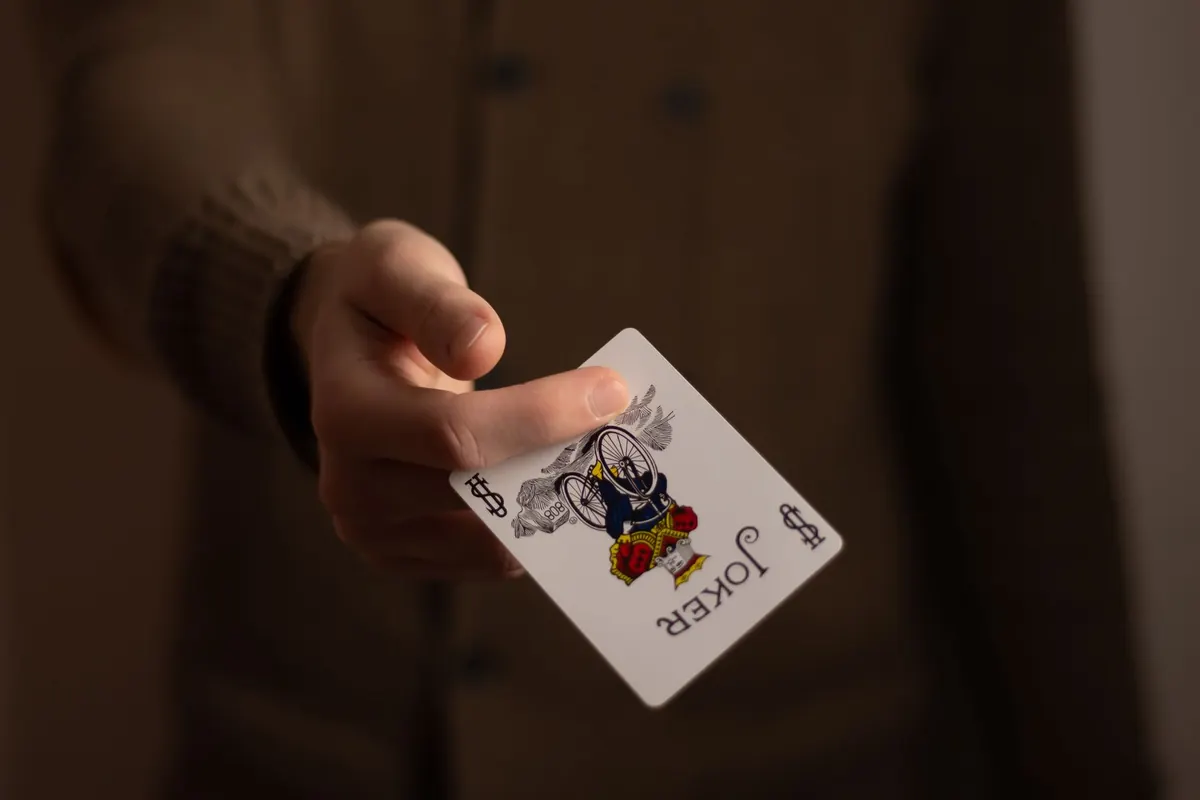
Finesse or Drop? A Practical Explainer for Suit Combinations
You have nine trumps between the two hands, the queen is missing, and the contract rests on the next three tricks. Hook it, or bang down the ace and king? Most players decide by feel. It is a better decision than you might expect — and it runs on two or three numbers that never change.
You don't need a simulator or a head full of tables with decimal places. You need to know how many cards are missing, what the auction told you, and what happens if you're wrong. Here is the practical version.
What Each Play Is Really Trying to Do
A finesse is an attempt to win a trick with a card that isn't yet the highest one. You lead toward a tenace — ace-queen, king-jack, ace-jack-ten — hoping the missing honor sits with the opponent who has to play before your honor does. If it's there, you collect a trick you had no right to expect.
Playing for the drop is the opposite idea. You cash your high cards and hope the missing honor was short enough to fall. Instead of guessing where the card lives, you bet on how the suit splits.
Both plays come up in the same layout: you hold enough cards that the missing honors might be only doubleton or trebleton, and you have a tenace that can hook them. That intersection is where the arithmetic starts to matter.
The Numbers You Actually Need
Start with the finesse, because it's simple. A missing honor is onside or offside, and with no other information the chance is essentially even. Call it 50 percent. That's the bar the drop has to beat.
Now the shape of the missing cards. When you and dummy hold eight or more cards in a suit, the defenders hold five or fewer, and the odds look like this:
- Holding 8, missing 5: the suit splits 3-2 about 68% of the time, 4-1 about 28%, and 5-0 about 4%.
- Holding 9, missing 4: 2-2 about 41%, 3-1 about 50%, 4-0 about 10%.
- Holding 10, missing 3: 2-1 about 78%, 3-0 about 22%.
Those three lines explain almost everything. Hold nine cards and miss the queen: cashing the ace and king drops a singleton or doubleton queen roughly 53% of the time, while the finesse brings home about 50%. The drop is better, but only barely.
Hold only eight cards and the arithmetic flips hard. For the drop to work, the queen must be singleton or doubleton — about a third of the time. The finesse is still near 50%. Hook it.
Hold ten cards and it isn't close: cashing the top honors works unless the suit breaks 3-0, so roughly 78%.
Eight Ever, Nine Never — With the Fine Print
Every player hears the rhyme early: eight ever, nine never. With eight cards, take the finesse; with nine, play for the drop. Now you can see where it comes from — and where it frays.
The "nine never" half is a three-point edge. Three points. That is not a law of nature; it is a tiebreaker. Any real information about the hand — an overcall, a preempt, a revealing opening lead, an opponent who passed throughout — can swing three points and reverse the right answer.
What the rhyme does do is get you close in a hurry. With nothing at all to go on, follow it and move on.
When the Auction Overrides the Arithmetic
Cards you know an opponent holds are cards they don't hold elsewhere. A defender who preempts with seven hearts has six slots left for the missing queen; the partner has thirteen. The same logic applies to a long overcall or a suit that shows up in the play. Length in one place means less room for honors in another.
A few clues are worth weighing before you commit:
- A preempt or a long overcall leaves that defender with fewer vacant places for the missing honor.
- A strong notrump opening, or a strong artificial club, suggests the missing high cards sit in that hand.
- The opening lead says something about length — a lead from a five-card suit is more likely than one from a three-card suit.
- Silence matters too. An opponent who had a cheap chance to bid a suit and didn't probably isn't long in it.
None of that is proof. But when you're choosing between a 50% finesse and a 53% drop, a mild inference is plenty to tip you.
Count First, Guess Later
Strong players delay the critical guess whenever the layout allows. Play off your long suits, count the discards, watch what the defenders keep. A defender who turns up with unexpected length in a side suit changes the whole picture, and you'd rather learn that before you commit than after.
Cash one honor first when it's free. With nine cards and the queen missing, laying down the ace costs nothing. If the queen is singleton, it appears and the guess is over. If it doesn't, you can still choose between the drop and the finesse — now with one more piece of information in hand.
Watch for restricted choice. When a defender plays one of two touching honors, they may have had no choice at all. If the queen appears on your ace and the jack is also missing, the jack is more likely to sit with the partner — roughly two to one. It's a small edge, and it settles a surprising number of real guesses.
Check the exit before you commit. Ask what happens if the finesse loses. Can you afford to be on lead in the wrong hand? Are the entries still there to reach the tenace twice if you need to? Sometimes a percentage line becomes the wrong line because the defenders cash five tricks in a side suit the moment you give up the lead. Take the sure plus score instead.
A Short Checklist at the Table
- Count your cards and the missing cards. Eight, nine, or ten?
- Ask what the auction and the opening lead said about the defenders' shapes.
- Count the hand as the play unfolds — the odds move with every discard.
- Cash a top honor first when it costs nothing, then decide.
- Check entries and the cost of failure before you touch the critical card.
- With eight, finesse. With nine, drop, unless an inference says otherwise. With ten, cash.
Make It Automatic
You don't have to memorize tables. Three numbers do most of the work: a finesse is about 50 percent, the drop with nine cards is about 53 percent, and the drop with eight cards is about 33 percent. Everything else is counting and listening.
Drill it at home when you have ten minutes. Deal a suit — ace-king-jack-small-small opposite small-small-small — and play it both ways against the defenders' actual cards. Deal it twenty times and you'll internalize how often the queen falls and how often it sits exactly where you want it.
At the table, add one habit: before you play the critical card, say the number to yourself. Eight, nine, or ten? Onside or not? That small pause is usually worth a trick a session, and a trick a session is a lot of matchpoints.
Photo: Ilias Saltidis / Pexels

Summer Bridge in the Park: How to Organize a Casual Outdoor Game
A shade tree, a folding table and a plan: how to run a friendly outdoor bridge game that survives wind,...
Teams vs. Pairs Scoring: How the Strategy Changes at Every Level
Matchpoints rewards overtricks and field awareness; IMPs rewards safety and arithmetic. Here's how the...
About Us